Fire Safety Doors
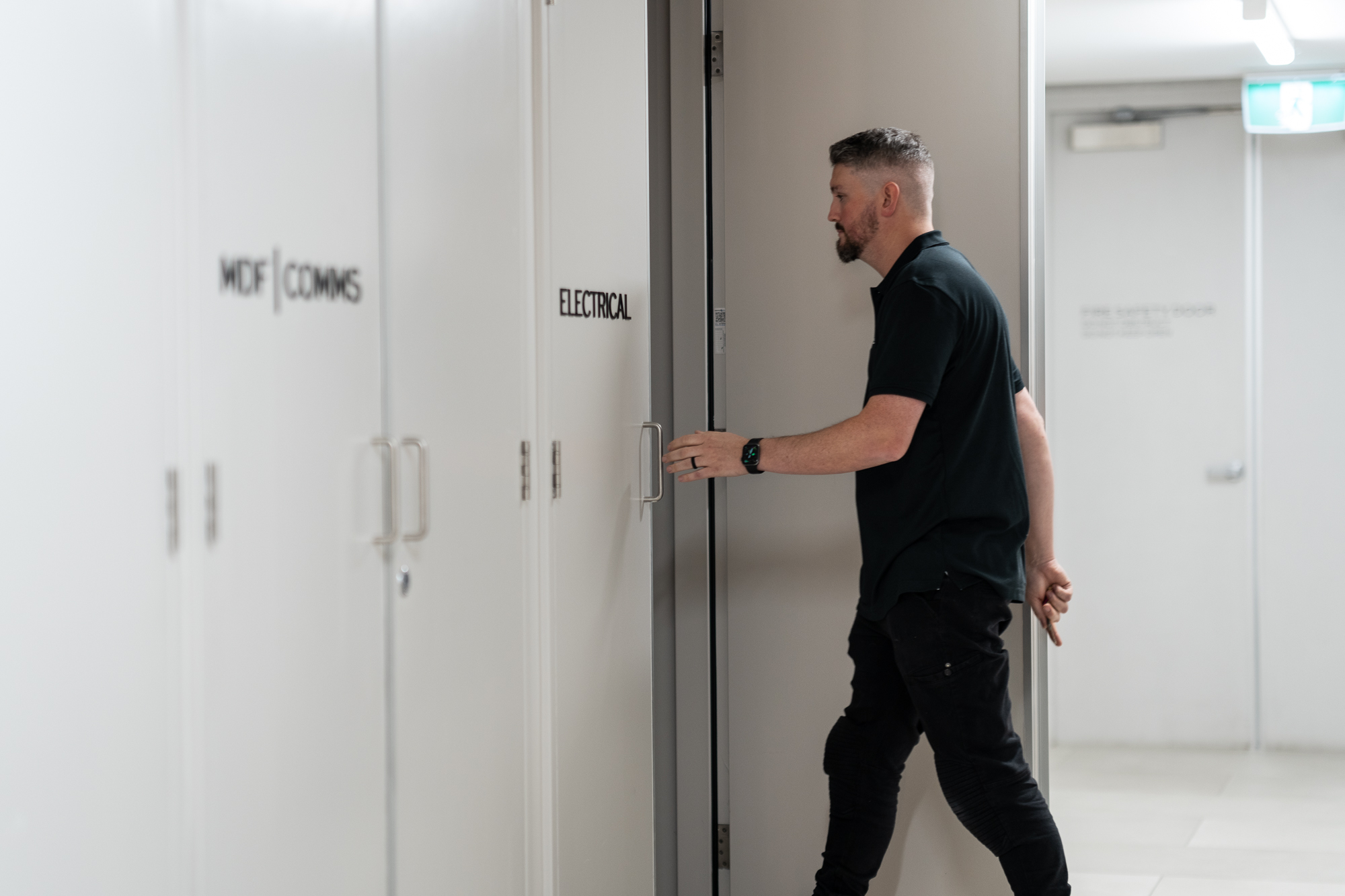
Non-combustible linings in service cupboards are easy to overlook, but they play an important role in protecting people during a fire. In many buildings, electrical or communications cupboards open directly onto corridors, hallways and lobbies that form part of the path occupants rely on to evacuate. When that happens, the cupboard cannot be treated as a harmless joinery item. It becomes part of the broader fire-safety picture.
That is why the National Construction Code has long regulated services and equipment installed in exits and in corridors, hallways, lobbies and similar areas leading to an exit. In NCC 2019 and later, D3D8 allows certain electrical and communications equipment in these locations only where the enclosure is suitably sealed against smoke spread and is either non-combustible construction or protected by a fire-protective covering. Earlier editions used D2.7 in substantially the same way.
Why this requirement exists
A path of travel is meant to give occupants a safer way out of a building. If a service cupboard opening onto that path contains combustible backing, combustible lining, or an enclosure that allows smoke to leak out early, the route can become compromised much sooner than intended.
This matters because many of these cupboards house equipment such as electricity meters, distribution boards, ducts, telecommunications equipment, or motors serving building systems. The NCC guidance makes clear that these installations are controlled precisely because paths of travel and exits need to remain usable during an emergency.
In simple terms, the safer the evacuation route, the better the chance occupants have of moving away from danger before smoke and heat build up.
What the NCC is really trying to prevent
The core issue is not whether the cupboard door is open or closed during normal use. The issue is what happens when there is an electrical fault, localised fire, or smoke event involving the equipment inside.
If the cupboard enclosure includes combustible materials such as MDF, plywood or timber backing boards, those materials can add fuel to the fire. If the enclosure is not suitably sealed, smoke can move out into the corridor earlier than it should. NCC D3D8 is directed at reducing that risk by limiting what can be installed in those locations and by requiring the enclosure to be non-combustible or fire-protected and smoke-sealed. Earlier NCC and BCA editions addressed the same concern through D2.7.
That makes this less about cosmetic construction and more about protecting the reliability of an evacuation route.
Common examples of non-compliance
This issue often arises during fit-outs, refurbishments or service upgrades rather than during the original build. Common examples include:
These defects can be easy to miss because the cupboard may look neat and finished from the corridor side. But compliance is not judged by appearance alone. It depends on whether the enclosure still meets the requirements applying to that location.
A common misconception
One of the most frequent misunderstandings is that the cupboard only contains “services”, so the materials around those services do not matter.
They do.
The NCC does not simply ask what equipment is in the cupboard. It also addresses how that equipment is enclosed when it is located in a required exit or in a corridor, hallway, lobby or similar area leading to an exit. That is why combustible internal backing can still be a defect even when the cupboard door itself looks solid and well finished.
Another misconception is that if a backing board is needed to mount equipment, any practical substrate will do. In reality, convenience does not override the construction requirements. If mounting is required, the mounting method still needs to be compatible with a compliant enclosure.
Why non-combustible construction matters
Non-combustible construction helps reduce the chance that the cupboard itself becomes part of the fire problem. The broader testing framework for combustibility in Australia is addressed in AS 1530.1, which sets out the combustibility test for building materials. That does not mean every cupboard needs to be described in technical laboratory language, but it does reinforce the principle that material choice matters in life-safety areas.
In practice, the purpose of non-combustible linings or non-combustible construction is to help:
That is a practical outcome occupants benefit from, even if they never notice the cupboard itself.
Why it should be treated as a defect
Where a service cupboard in a path of travel is lined or backed with combustible materials contrary to the applicable NCC requirements, it should be treated seriously. It may not be the most visible defect in a building, but it can affect one of the most important parts of emergency movement: keeping the route to an exit safer for longer.
For owners and managers, the risk is not only regulatory. It is also operational. A cupboard that seems minor on a drawing can become very significant when it opens directly onto a corridor used by occupants every day.
What building owners and managers should check
If you are reviewing a service cupboard that opens onto a corridor, hallway, lobby or similar access route, it is worth checking:
Where there is doubt, the cupboard should be assessed by a suitably qualified fire-safety or building compliance professional.
Service cupboards in paths of travel are not just storage boxes for building services. In the wrong condition, they can add smoke and fire risk to the very areas people depend on to get out safely.
That is why the NCC has long controlled these installations through D2.7 in earlier editions and D3D8 in more recent editions. The principle is straightforward: if a cupboard opens onto an evacuation path, its enclosure needs to support the safety of that path, not undermine it. Using non-combustible linings and appropriate smoke sealing is part of achieving that outcome.