Door Frames
Fire Door Stops
Why Fire Door stops are always required to be 25mm and no less?
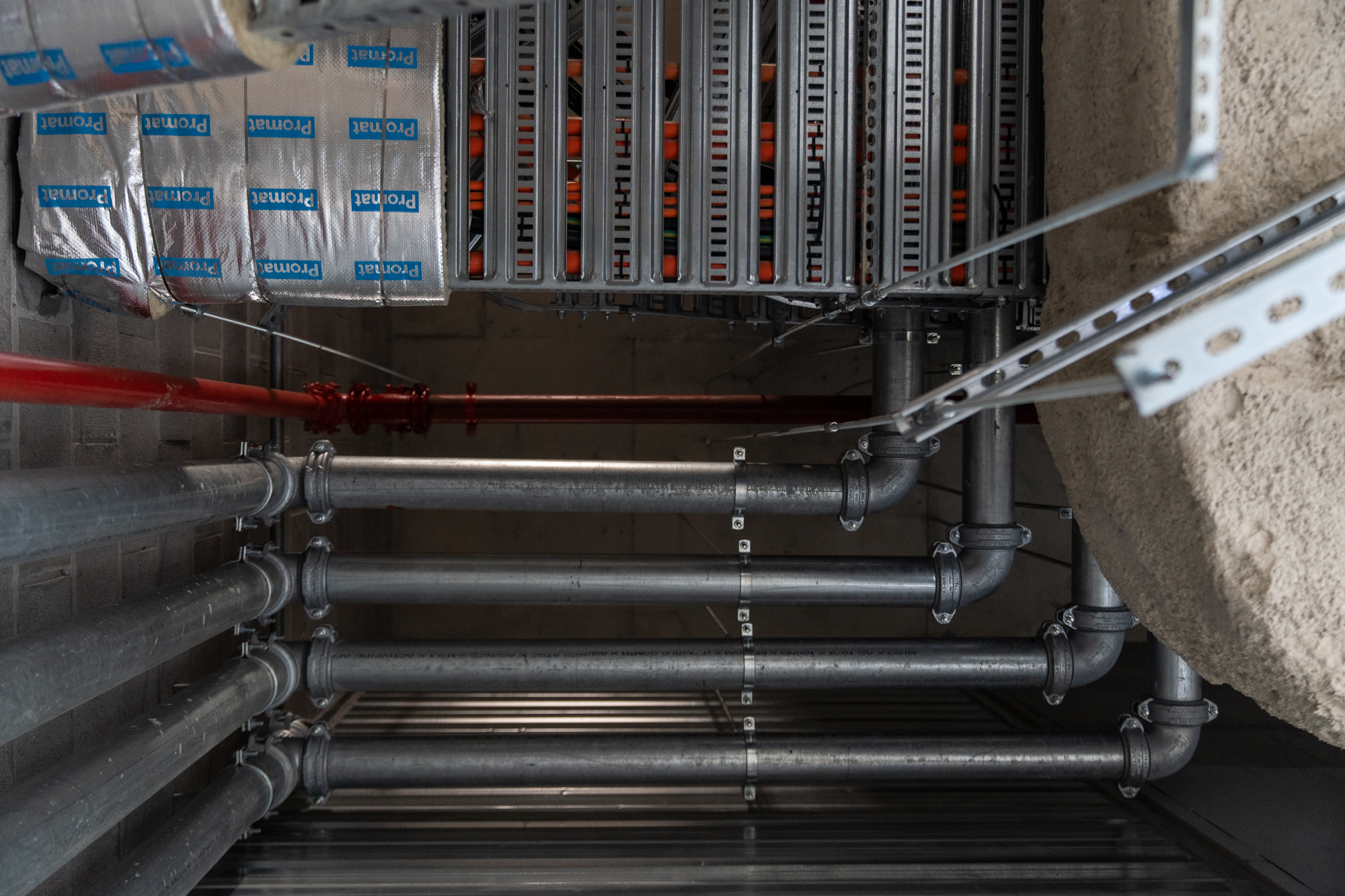
When it comes to service penetrations, one of the most common defects we see is multiple services being run through a single opening and then sealed as though any fire-rated product will make the installation compliant.
That is not usually how passive fire compliance works.
In a fire-rated wall or floor, the opening created for services has to be protected by a system that has been tested for that condition. If different services are combined in one penetration, the installation usually needs to match a specifically tested mixed-service system, not a site-made arrangement. This aligns with the NCC approach to protecting service openings and with Sentry’s broader project guidance to explain complex compliance issues in clear, practical terms.
The reason services are often required to be separated is simple: separation allows the installer to use a system that has actually been tested for the service type, substrate and opening condition.
A single pipe through a wall may have one tested solution. A cable bundle may have another. A conduit may have another again. But once those services are grouped together through one small opening, the penetration becomes a different condition entirely. At that point, compliance depends on whether that exact arrangement has been tested or is otherwise permitted under the NCC.
This is where many non-compliant installations occur. A penetration may look neat after sealant, mortar or a fire-stopping product is applied, but appearance is not the test. The real question is whether the system installed matches a proven, compliant detail.
The NCC guidance for C4D15 Openings for service installations explains that service openings must be protected so the fire performance of the wall or floor is maintained. The NCC points to tested prototypes in accordance with AS 4072.1 and AS 1530.4, along with limited Deemed-to-Satisfy pathways.
In practical terms, that means all services should be installed through a system that has been fire tested for the way they are actually arranged. It is not enough for an individual product to simply be described as “fire rated.” The tested system has to suit the penetration type, service type, annular gap, support construction and overall assembly.
A typical real-world example is where pair coils, conduits and PVC services are all run through a single penetration and then sealed together with a generic fire-stopping material.
That type of installation is often non-compliant because those services are different in material, behaviour and fire response. Cables and cable trays are commonly treated as one style of tested installation. Pipes on their own may be tested under another. But mixed penetrations involving several unrelated services generally need their own tested system. You cannot safely assume that because each service has a fire-stopping solution on its own, they can all be combined in one hole.
This is especially common in tight areas where installers are trying to save space or reduce core holes. Unfortunately, those convenience-based decisions can undermine the fire-resisting performance of the barrier they are penetrating.
One of the biggest misconceptions in passive fire protection is that “real world” site conditions justify improvisation.
They do not.
Cables and cable trays may be common on live projects. Pipe bundles may also be common. But common does not automatically mean compliant. The standards still rely on test evidence, and the NCC still expects openings for services to be protected in a way that preserves the required fire performance.
That is why installers, builders and building managers need to be careful with mixed penetrations. Once too many services are forced through the same opening, there may be no tested system that legitimately applies to what has been installed.
There are situations where multiple services genuinely do need to pass through a small access point. A common example is above apartment entry door heads in Class 2 buildings, where space is limited and several services may need to enter the compartment.
In those cases, the answer is not to improvise a combined penetration. The answer is to use an appropriate certified mixed-service system.
Products such as the BOSS FyreBox are designed specifically for this kind of application. BOSS describes FyreBox as a multi-service fire-rated transit system that allows electrical, plumbing and HVAC services to pass through a single compact fire-rated enclosure while maintaining compliance when used within its tested scope. That makes it a useful option where multiple services need to enter through one small location and a tested solution is required.
For owners, strata managers and project teams, non-compliant penetrations are rarely minor issues.
If a mixed-service penetration has been installed without a valid tested system, rectification can mean reopening the wall or slab, separating services, resizing the opening, or replacing the fire-stopping arrangement entirely. That creates cost, disruption and avoidable delays.
It is far better to plan penetrations properly from the outset, especially in congested areas where several trades are working in the same zone. Early coordination often prevents the kind of combined installations that later become defects.
A lot of people assume that if a sealant, collar or penetration product is labelled fire rated, it can be used almost anywhere.
That is not correct.
Fire-stopping products are not universal approvals. Their compliance depends on how they are used and whether the installed arrangement matches the tested system. Once the mix of services, opening size or substrate changes, the compliance pathway may change with it.
That is why the product alone is never the full answer. The full tested assembly is what matters.
Multiple types of services should not be installed through the same penetration unless an appropriate tested and certified system has been selected for that exact arrangement.
Where services need to be separated, they should be separated. Where several services genuinely must pass through one opening, the solution should be a compliant mixed-service system with the right test evidence behind it.
That is the safest way to preserve the fire-resisting barrier, support compliance with the NCC, and avoid expensive defects later.