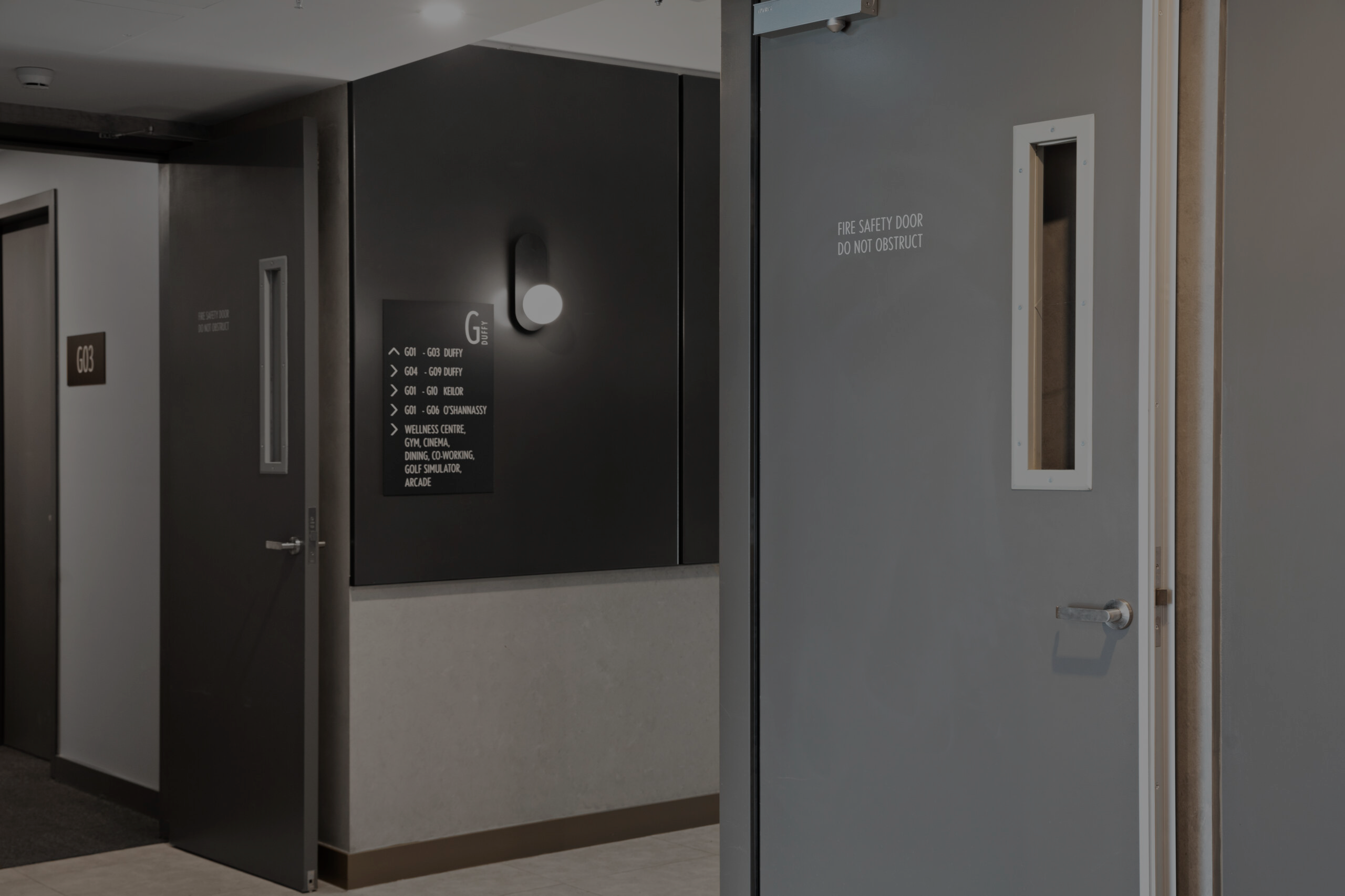
Fire Safety Doors

A fire safety door is not just a door leaf inside a frame. It is a complete, tested assembly made up of the door leaf, frame, hinges, latch, lockset, handles, strike plates, fixings and other associated hardware. In Australia, fire-resistant doorsets are governed by AS 1905.1, with fire-resistance testing carried out under AS 1530.4. The NCC 2022 Specification 12 also requires fire doors to comply as regulated building elements, not as partially completed door sets.
That distinction matters.
When a fire door is tested, it is assessed as a complete doorset, not as a basic panel that can later have parts removed without consequence. This is exactly the type of practical compliance issue these project articles are meant to simplify for building owners, managers and the general public, while keeping the tone professional and easy to understand.
A common defect found during inspections is missing hardware. That might include:
These issues are often treated as minor maintenance items, but on a fire door they can be much more serious. Once components are missing, the installed doorset may no longer reflect the configuration that was originally tested and approved.
In simple terms, if part of the hardware assembly has been removed, the fire door may no longer be installed in its entirety.
Fire door hardware is not just there for convenience. Each component plays a role in how the door performs in real conditions.
The latch helps the door close and stay shut. The handles and lock furniture are part of the operating hardware tested with the leaf. Strike components help ensure the latch engages correctly. Fixings and cover items can also be important where they form part of the tested arrangement and protect penetrations or prepared cut-outs in the door.
If any of these parts are removed, damaged or replaced with non-matching items, the door may no longer operate as intended. That can affect whether it fully closes, positively latches, or maintains the integrity expected of a fire-rated doorset.
This same principle appears across other fire protection systems too: products are expected to be installed in the form they were tested and approved, not altered on site in an ad hoc way. Sentry’s article on Correct Fire Collar Fixings is a good example of how even a small change to an installed fire protection system can affect compliance, while the article on Fire Door Stops shows how a seemingly simple door component still plays an important role in overall doorset performance.
One of the most common misunderstandings is this: “The door still opens and shuts, so it should be fine.”
That is not how fire doors are assessed.
A fire door is not judged only by whether it swings freely in everyday use. It must remain a compliant protective barrier under the building code and relevant standards. If the hardware is incomplete, loose or missing altogether, the door may still appear usable while still being defective from a fire safety perspective.
That is especially important in occupied buildings, where people rely on these doors to slow the spread of fire and smoke and protect paths of travel.
If a fire door is found with missing handles, latches, lock barrels or other hardware components, the right response is not to improvise.
The door should be checked against the approved or tested configuration for that doorset, and any missing or incorrect parts should be reinstated appropriately. That may involve the door manufacturer, certification pathway, approved hardware details, or specialist fire door contractors. The goal is to restore the door to the compliant assembly it is meant to be, not simply make it look complete again.
This issue often appears alongside other defects such as damaged smoke seals, incorrect gap tolerances, loose hinges or failing latching hardware, all of which can affect the way the complete doorset performs.
A fire safety door must be installed and maintained as a complete tested assembly. Missing lever handles, latches, lock barrels and other hardware are not just cosmetic defects. They can mean the installed door no longer matches the system that was fire tested under AS 1530.4 and required to comply with AS 1905.1 and the NCC.
In fire safety, partial hardware is not full compliance. The complete assembly matters because that is what was tested, and that is what helps protect people and property when it matters most.