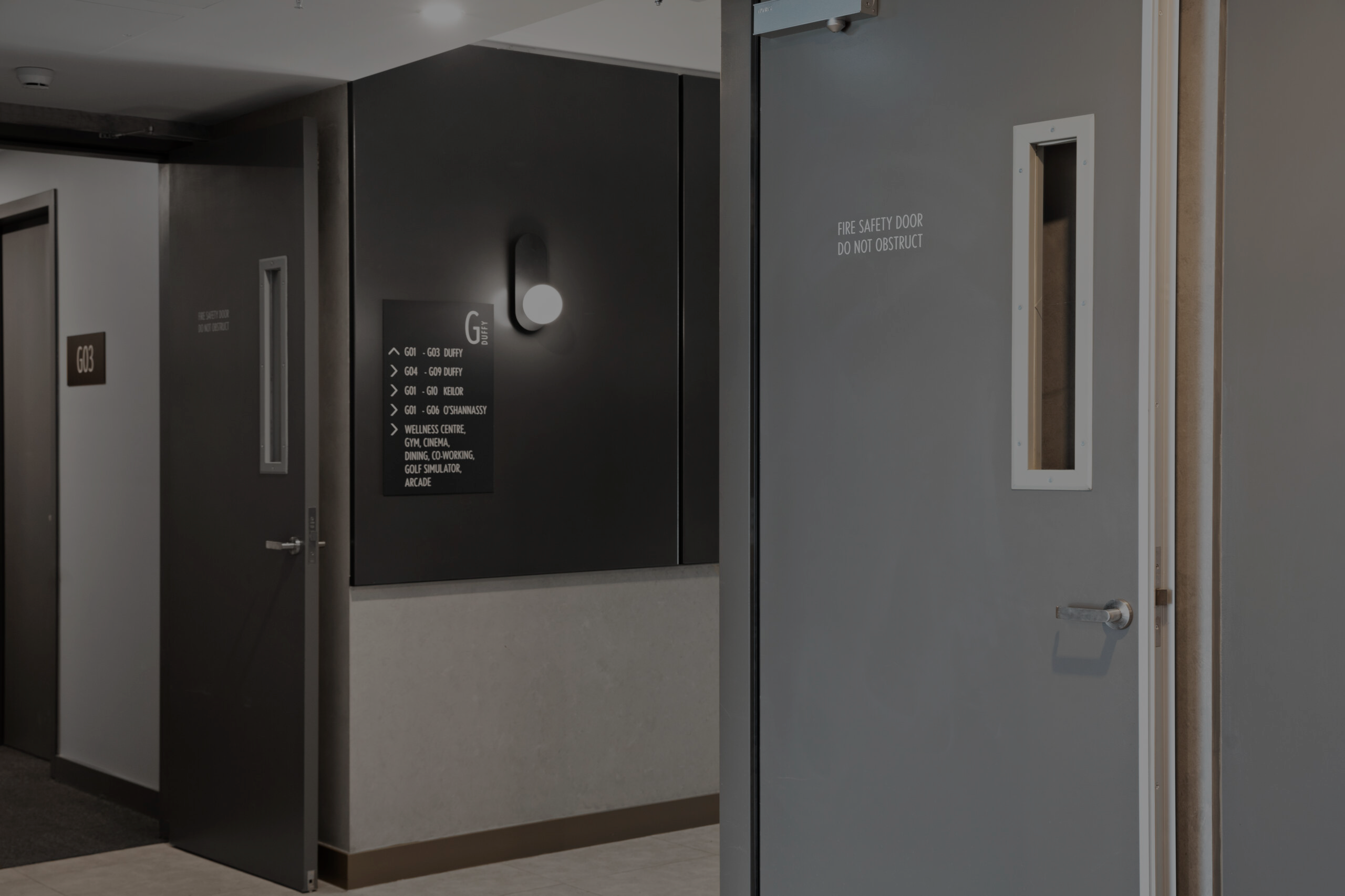
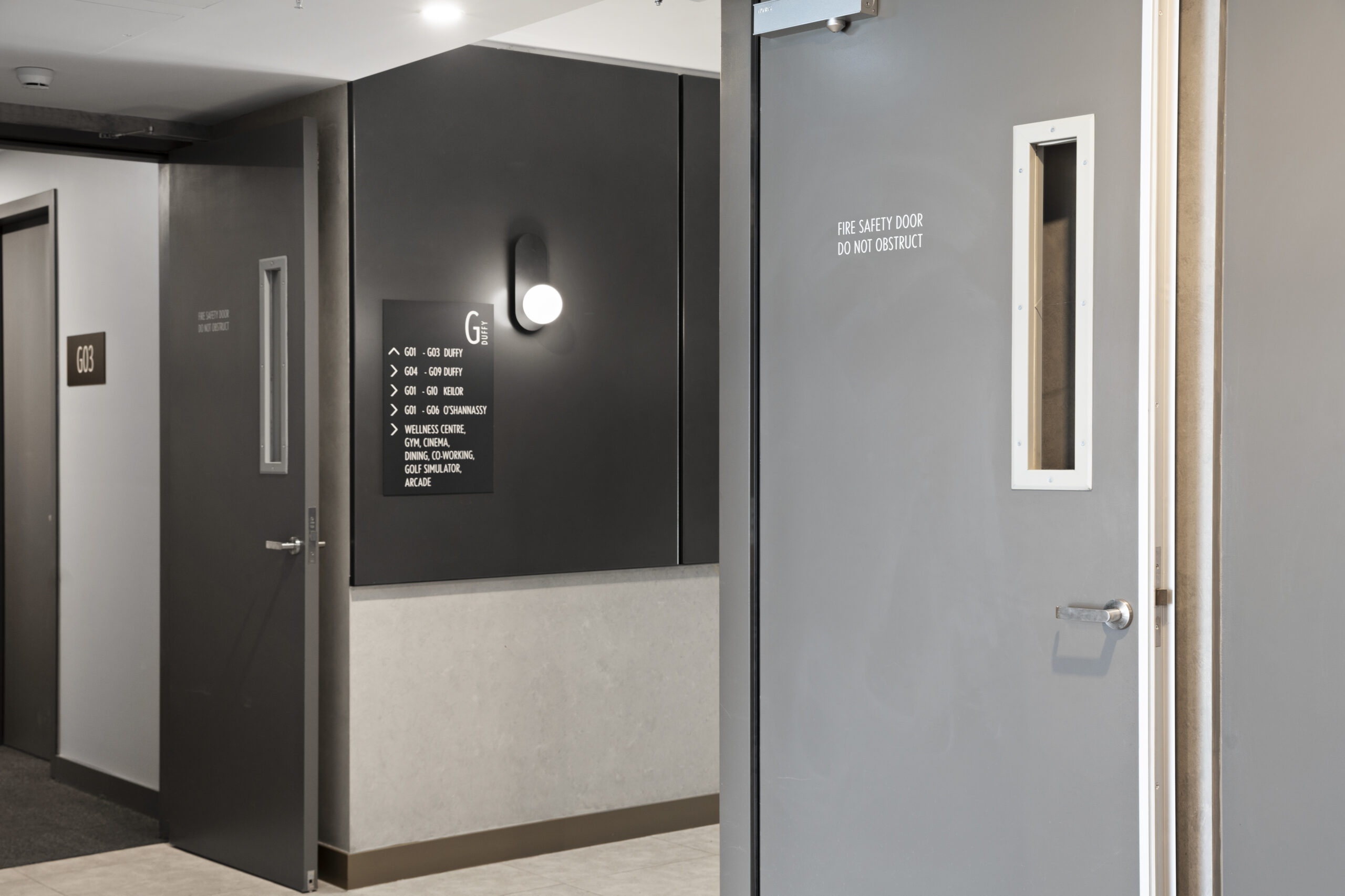
Fire Safety Doors
A compliant fire door threshold gap is a small detail that carries a big responsibility. Under AS 1905.1, Clause 5.5.1 states that the clearance between the bottom of the door leaf and the finished floor surface, including any floor covering, must not be more than 10mm. That limit is there for a reason: if the gap is wrong, the doorset may not perform the way it was intended to during a fire.
Fire doors are not ordinary doors. In the National Construction Code, required fire doors must comply with AS 1905.1 as part of the Deemed-to-Satisfy provisions for protecting openings. In other words, compliance is not just about having a fire-rated label on the door. The installation details matter as well, and the threshold gap is one of them.
When a fire door is tested, it is assessed as a complete assembly. That includes the leaf, frame, hardware, seals and clearances. If the gap at the bottom becomes too large, it can undermine the way the doorset restricts the movement of hot gases, smoke and flame. Even where the door still appears to close and latch, an excessive bottom clearance can leave an avoidable weakness at the base of the opening.
This is one of the reasons fire doors should never be judged by appearance alone. A door can look solid and still be non-compliant if the floor finish has changed, the door has been trimmed, the frame has moved, or the original installation did not account for final floor levels. Those practical site issues are common, especially in existing buildings where carpet, tiles or vinyl may have been added or replaced after the door was installed. Guidance and product literature across the Australian fire door market consistently reflect the need to maintain the allowable bottom clearance.
The most obvious risk with an oversized threshold gap is loss of performance. If the opening at the bottom is greater than permitted, the door assembly may no longer reflect the tested configuration it relies on for compliance. That can affect fire and, where relevant, smoke performance as well. Some retrofit upgrade products exist specifically because oversized bottom gaps are a known compliance issue in the field.
There is also a practical safety issue. Once a gap becomes excessive, building managers sometimes try to solve it in improvised ways: fitting non-tested strips, packing the bottom edge with unsuitable materials, or installing ad hoc threshold pieces without checking compatibility with the doorset. Those shortcuts can create a new defect instead of fixing the original one. Any rectification should suit the specific doorset and be supported by appropriate test evidence, manufacturer guidance or proprietary system approval. That is the careful, accountable approach fire door compliance demands.
It is easy to assume that smaller must be better. Not necessarily.
If the threshold gap is too tight, the door leaf may foul on the floor or floor covering. That can stop the door from closing freely, prevent it from latching properly, or cause ongoing wear to the door edge and hardware. A fire door only helps when it can reliably close into its frame and stay there. A door that drags, sticks or needs force to shut is not a good outcome simply because the gap is small. The goal is not the smallest possible clearance. The goal is the correct clearance.
This is where the threshold gap becomes a balance between performance and operation. The door must move properly in everyday use while still remaining within the permitted tolerance set by the standard. That is why threshold issues should be measured carefully and rectified properly, not guessed.
Where the bottom gap is too large, one common solution is a tested fire door bottom upgrade seal or a compatible threshold arrangement that restores the effective clearance and sealing performance. Australian product literature shows that retrofit bottom upgrade systems are specifically marketed for doors where the bottom gap exceeds the allowable 10mm under AS 1905.1, subject to the relevant proprietary approvals.
Another practical rectification method is the use of threshold plates. These are installed at the sill to create a more suitable sealing surface and, in many cases, to help the bottom seal work effectively against an uneven or problematic floor finish. Suppliers such as Raven, Kilargo and Lorient describe threshold plates as providing an improved sealing surface and helping door bottom seals perform properly.
Where the floor level transition itself is the issue, ramp plates may also be used. These are commonly intended to compensate for uneven floors, level changes, carpet edges or trolley and wheelchair traffic, while still creating a more controlled threshold condition at the doorway. That can be especially useful where the problem is not the door leaf alone, but the relationship between the leaf and the finished floor build-up.
Where the gap is too small, rectification may involve adjusting the door, addressing the floor finish, or using a threshold profile that creates a more suitable landing and running surface without causing the leaf to bind. But the same rule applies either way: the fix must be appropriate to the tested doorset and compatible with the required fire and smoke performance. It is not just a carpentry issue. It is a compliance issue.
The fire door threshold gap is a good example of how small defects can become meaningful risks. A few millimetres at the bottom of the leaf may look minor, but in a compliant fire doorset, tolerances matter. They matter because the door is part of a system designed to protect people, contain fire, and support safer evacuation. The right outcome is not guesswork or a quick cosmetic fix. It is a compliant, tested, well-considered rectification that returns the door to the standard it is meant to meet.
For more background, this topic sits closely alongside fire door stops and smoke seals, because all three affect how well a door closes, seals and performs as an assembly.