
Fire Safety Doors
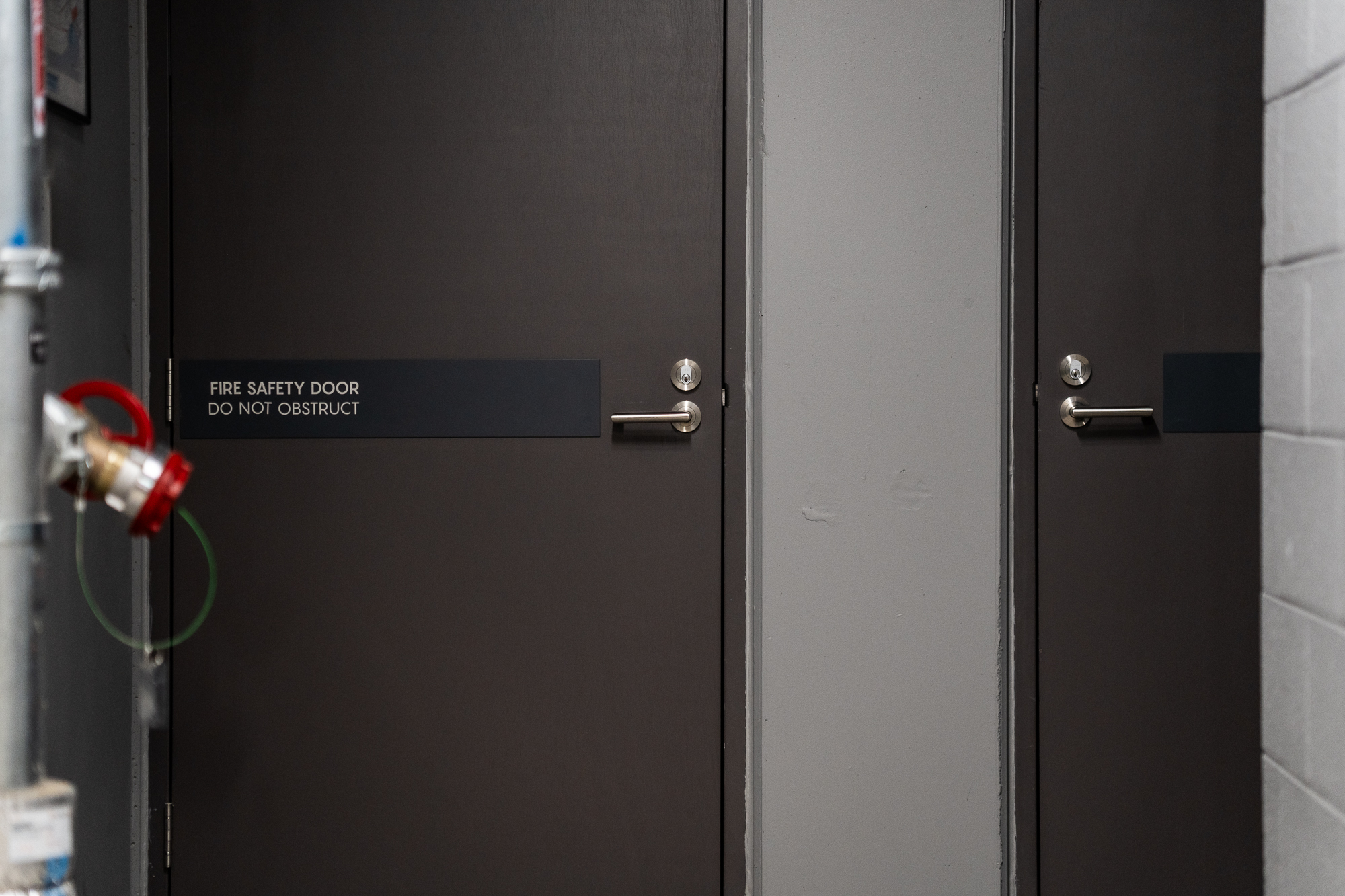
Fire stair door signage is often treated as a minor finishing detail, but in practice it is an important part of how a building communicates safe egress during an emergency. One situation where signage becomes especially important is when a fire-isolated stairwell does not discharge directly to a road or open space, but instead discharges internally and relies on a further path of travel out of the building.
In that case, the door arrangement is no longer just a simple “stair to outside” scenario. Occupants may be moving from the stairwell into another part of the building that still forms part of the required exit path. That changes how the door should be understood, and why signage on both sides can become necessary under the NCC. The NCC 2016 requires signs on certain doors so occupants do not obstruct them, prop them open, or otherwise impair their operation, because those doors are part of the life safety system.
Under NCC 2016 D2.23(a)(ii)(A), signage is required on each side of a fire door forming part of a horizontal exit. The NCC defines a horizontal exit as a required doorway between two parts of a building separated from each other by a fire wall. It also defines required as something required to satisfy a Performance Requirement or Deemed-to-Satisfy Provision. In other words, if the doorway is part of the required exit arrangement, the signage obligation is not optional or cosmetic. It is tied to the building’s compliance pathway.
The reason signage is needed on both sides in this type of arrangement is simple: people approach the door from both directions.
Where a fire-isolated stair discharges directly to a road or open space, the purpose of the final door is usually obvious. But where the stair discharges internally, there is greater risk of confusion. A person exiting the stair may not realise the next doorway is still part of the required exit path. A person on the other side may see it as just another internal door and obstruct it, wedge it open, store items near it, or alter its operation.
That is exactly the kind of risk D2.23 is trying to address. The NCC intent is to alert people that the operation of these doors must not be impaired, because if they are blocked or held open, the effectiveness of the fire- and smoke-separated egress path is compromised. The code even prescribes the wording and format of the sign, including capital letters at least 20 mm high in contrasting colour. For a self-closing door, the required wording is:
FIRE SAFETY DOOR
DO NOT OBSTRUCT
DO NOT KEEP OPEN
A common misconception is that once a person is inside a fire-isolated stair, the signage issue is finished. That is not always the case.
If the stair does not discharge straight to the outside, the discharge arrangement must still preserve the protected path of egress. Depending on the design, that can involve a doorway that forms part of a horizontal exit or another required exit component. Where that doorway falls into the category described by D2.23(a)(ii)(A), signage is needed on both faces of the door, not just the approach side from within the occupied floor.
This matters because emergency egress is not only about helping occupants find an exit. It is also about protecting the integrity of the doors that keep exits usable. A missing sign can seem minor during routine use, but in an emergency it can contribute to doors being misused, left open, or treated as ordinary internal doors. That is when a protected path can stop functioning the way the building design intended.
In practice, this defect often appears after refurbishments, repainting, door replacement, or fit-out works.
A building may have a compliant stair and compliant fire doors, but the signage is removed, painted over, replaced with non-compliant wording, or only installed on one side. That leaves the door hardware and fire-resisting construction in place, but the mandatory warning function is lost. This is especially common where internal discharge arrangements are not well understood by contractors or maintenance teams.
The risk is not theoretical. When signage is absent, people are more likely to:
That is why the NCC treats signage as part of the broader exit protection strategy, not as a decorative label.
If a fire-isolated stairwell discharges internally rather than directly outside, the discharge door arrangement should be checked carefully against the NCC, particularly where a horizontal exit is involved.
The key question is not just, “Is there a sign on the door?” The better question is:
Is this a required fire door forming part of a horizontal exit or other protected discharge arrangement, and if so, is signage installed on the correct side or sides as the NCC requires?
That distinction matters. In the wrong configuration, a one-sided sign may be insufficient. For certain doors, the NCC clearly requires signage on each side so that anyone approaching the door understands it must not be obstructed or held open.
Buildings rely on layers of protection. Fire-rated construction, self-closing doors, latching hardware, stair pressurisation, smoke separation, and signage all work together. When one element is overlooked, the reliability of the whole system is weakened.
Correct fire stair door signage helps preserve the operation of the door, reinforces the purpose of the exit path, and reduces the chance of human behaviour undermining a compliant design. For owners, managers, and contractors, it is a small item with a very large safety outcome.
For reference, the relevant NCC sources are the official NCC 2016 Part D2 — Construction of Exits and NCC 2016 Part A1 — Interpretation, which set out the door signage requirement, the definition of horizontal exit, and the meaning of required.